
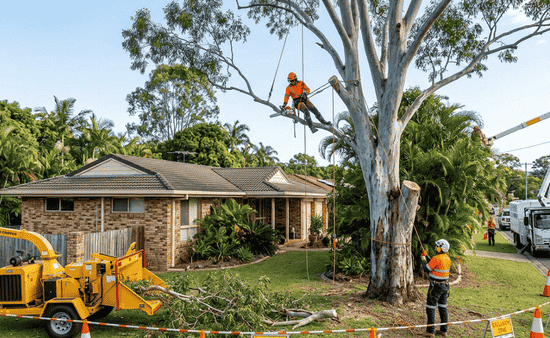
The felling of a big tree is an extreme labor that is fraught with a lot of dangers, more so when the tree is located near the housing units. The act of cutting down a tree, whether it is dead, sick, or has a structural hazard to the foundation of a home, must be done with precision on a surgical level. In cities and the suburbs, errors are not allowed; one wrong move can result in loss of property worth billions of dollars or fatal injuries.
The most important issue for any homeowner or contractor is safety. In the case of the distinct vegetation and restrictive property boundaries in Queensland, most residents have discovered that the most essential safety measure they can take is to find a qualified arborist near me Brisbane. Local specialists know the densities of native trees and the soils that may have a certain influence on a tree and its stability during the process of removal.
Understanding the Risks

IT is essential to recognize the Four Pillars of Risk of big tree elimination before cutting a single department:
- Structural Integrity: Large bushes near houses often have asymmetrical root systems or lean closer to the building to reach daylight, making their fall course unpredictable.
- Proximity to Utilities: Overhead strength traces and underground sewage pipes are regularly entangled with mature timber.
- Gravity and Mass: A unmarried big limb can weigh several hundred kilograms. It is reduced, and immediately the forces of gravity set in.
- Equipment Failure: Using the wrong tools or poorly maintained chainsaws will increase the chance of accidents.
1. Do a Detailed Site Evaluation
The initial safety measure is never to hurry on the actual work. There is more than a mere look-up when it comes to a professional-grade site assessment. You need to check the trunk in case of conks (fungal) growths, cavities, or cracks, which may indicate internal rot. When the tree is hollow, the conventional methods of cutting cannot be used since the so-called hinge wood, the section that determines the direction of the fall of the tree, is absent.
Additionally, consider the Drop Zone. It is a space at least twice the tree height that needs to be cleared of people, pets, and movable property. To lower the tree piece by piece instead of felling it all at once, special rigging is necessary when the building is in this zone.
2. Make Power Line Safety a Priority
One of the most common causes of fatalities in tree work is electrocution. Residential buildings are frequently intertwined with trees on service drop lines between the pole and the house.
- The 10-Foot Rule: When approaching energized power lines, always keep at least 10 feet (3 meters) away.
- Conductivity: Wet wood ladders and aluminum ladders are also good conductors of electricity.
- Professional Intervention: When a tree comes into contact with a power line, do not make an attempt to clear the power line yourself. This needs a professional Utility Arborist, certifiable to work on lines of high voltage.
3. Use the Correct Rigging and Cutting Techniques
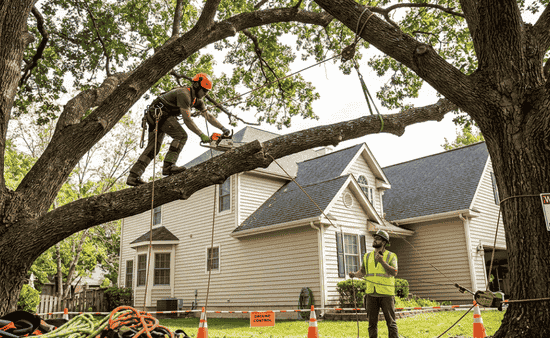
In the case of trees that are close to houses, it is seldom possible to cut the tree at the base (felling) to allow it to fall. Rather, the tree has to be taken apart. This is by having a climber or a bucket truck operator cutting off the branches at the base or at the top.
The art of descending heavy wood by means of ropes, blocks, and pulleys is called rigging. Rigging safety tips include:
- Weight Calculation: You should not cut a section whose weight exceeds the maximum weight that your ropes can support.
- The “Hinge” Cut: With an appropriate notch (as in the Open-Face Notch), the operator can steer the limb off the roofline.
- Ground Control: This individual on the ground operating the rope should be far out of the strike range to prevent being struck by the swinging limb.
4. Non-Negotiable: Personal Protective Equipment (PPE)
PPE is necessary even when you are merely the ground crew. A professional installation consists of:
- Chain-saw Chaps: These are invented so that when the chain is moving, it stops immediately it comes in contact.
- Arborist Helmets: These are fitted with chin straps to remain in place in case of a fall and come with inbuilt hearing protection.
- Eye Protection: So wood chips and “widow-makers” (falling dead branches) will not cause permanent eye damage.
- High-Visibility Clothing: This makes sure that the saw operator can always see the ground crews.
5. Weather Considerations
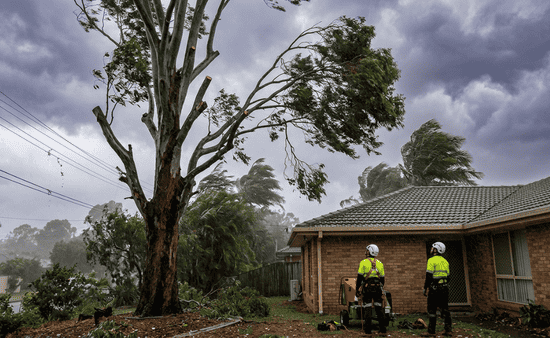
The climate of sub-tropical areas such as South East Queensland may shift very quickly. The foe of safe tree removal is wind. The canopy of a partially cut tree may be blown away by a sudden wind, like a sail, and the rest of the wood will break and crash against the residential building. In case of wind speeds of more than 25 30 km/h, the operation must be delayed. Rain, likewise, causes the bark to be slippery and power lines more hazardous.
6. Stump and Root System Management
Safety doesn’t end when the tree is on the ground. When trees are in proximity to buildings, the roots are usually mixed with the building foundation. Removal of a stump by heavy machinery may cause broken basement walls or broken pipes. The more conservative, safer way to go is to grind the stump, as the approach to the residence.
When to Engage the Professionals?
Although the DIY culture is robust, a massive cutting of trees is a field where doing it yourself can cost one both money and life. Professional crews have high-limit liability insurance, that in case they do strike a roof, the insurance company will cover the repair, not you. They also have specialized machinery, such as cranes and wood chippers, that ensure the process is much safer and quicker.
Summary of Safety Protocols:
| Protocol | Action Item |
|---|---|
| Exclusion Zone | Prep Zone 2x the height of the tree. |
| Utility Check | Find all overhead and underground lines. |
| Gear Audit | Check chainsaws are sharp, and ropes are in good condition. |
| Communication | Use conspicuous hand signals or radio headsets when saws are in use. |
Removing a large tree from a residential property is a complex engineering mission disguised as yard work. By following strict website exams, utilizing superior rigging strategies, and respecting the power of the elements, you can mitigate the number one risks to your property and your fitness. However, the complexity of dealing with large-scale wooden near-strength strains and structures frequently needs local understanding. For those dwelling within the Queensland capital, securing a reputable arborist near me Brisbane is the best way to ensure the activity is accomplished consistently with Australian Standards (AS 4373-2007). Ultimately, the fee of expert removal is a small rate to pay for the peace of thoughts that your private home—and your own family—remains safe at some point of the method.