


The trend in structuring contemporary clothing has shifted toward automated, high-volume production, replacing longevity on the inside with an appearance of similarity on the outside. Mass-produced clothes are made according to size schemes that treat the human body as a stable, uniform block rather than a mobile, asymmetrical figure.
Authentic longevity within the fashion industry requires altering one’s outlook and embracing bespoke tailoring according to one’s skeletal structure, a principle adhered to by tailored society bespoke services. In refusing to conform to an assembly-line mentality of fashion production, this artisan approach ensures that each stitch reflects the particular way that the body moves. To invest in clothing created in this manner is not to support the idea of throwaway fast fashion but rather to purchase heirloom garments that are meant to be worn for decades.
1. Defining True Customization: Bespoke vs. The Alternatives (Bespoke vs. MTM vs. RTW)
The exact demarcation lines between RTW, MTM, and bespoke can be determined by examining the structure behind them:
- Ready-to-Wear (RTW): Garments are mass-produced in standardized, fixed size ranges based on generalized body templates, offering no individual customization to the wearer’s specific anatomy.
- Made-to-Measure (MTM): Makes use of a digital block or factory master pattern that is already in existence and adjusts independently according to specific parameters such as chest width and sleeve length.
- True Bespoke: Completely eliminates the use of any existing pattern and creates a brand-new paper drawing tailored specifically to the individual’s unique posture, asymmetry, and spine.
2. The Internal Chassis: Why Construction Dictates Longevity (Suit Construction & Durability)
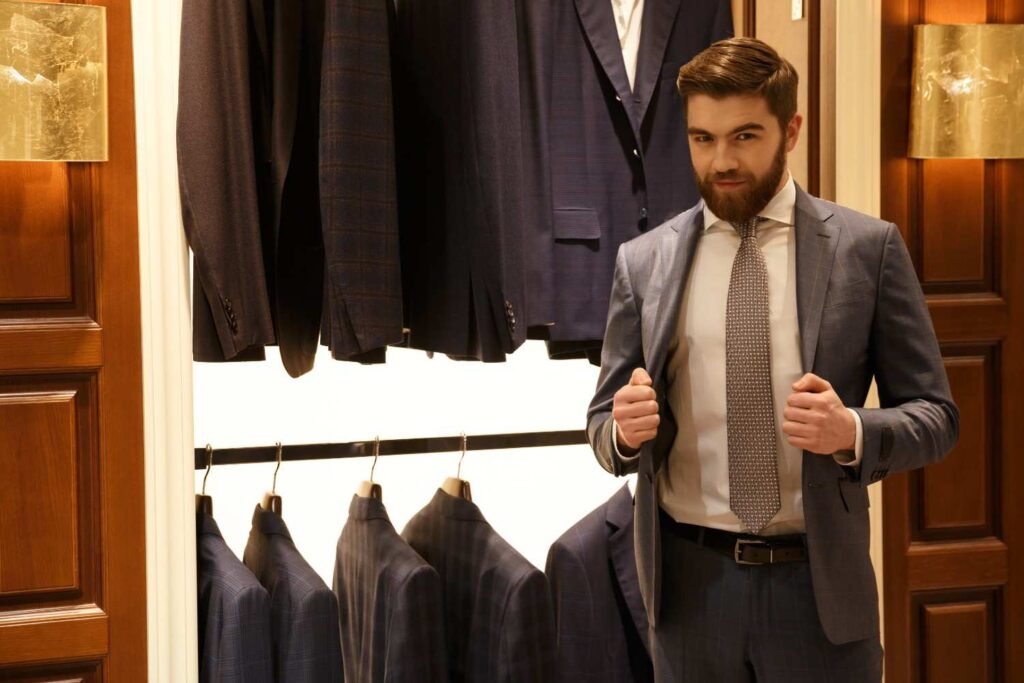
- Fused Interlining: Manufacturing through industry entails the heat pressing technique of fixing the artificial glue-backed interlining on the wool shell. This results in a chemical bond that creates an artificial rigidity and ensures that the wool is unable to bend. This results in a situation where the layers permanently come apart and form bubbles when subjected to environmental heat and dry-cleaning conditions.
- Floating Horsehair Canvas: A bespoke jacket requires a floating horsehair canvas, which consists of a chest piece constructed out of natural linen and unspun horsehair. The floating horsehair canvas is held in place using hundreds of small diagonal stitches, which allow the piece to move freely while imitating the contours of the body.
3. From Blank Page to Pattern: The Geometry of a Perfect Fit (Bespoke Suit Fitting Mechanics)
The skilled cutter sees the work as a twofold exercise of volumes and dynamics. While static dimensions give the simplest information, the intricacies come in when calculating anatomical irregularities like a dropped shoulder, a tipped neck, and even a twisted pelvis. It is by incorporating these particular irregularities into the first paper cut that the tailor ensures the jacket will hang perfectly balanced and not pull, catch, or break any of its straight lines upon movement.
4. The Human Element: Meticulous Hand-Stitching and Artistry (Handmade Suits vs. Machine-Made)
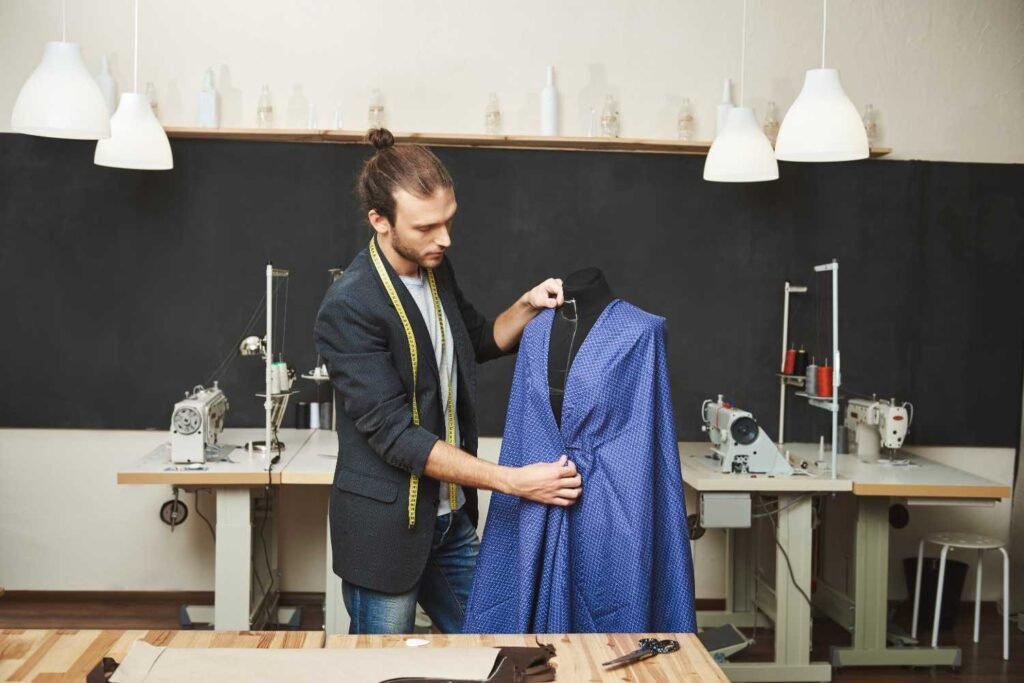
Due to machine constraints, the lockstitch is required, which rigidly tightens up the fabric and provides no elastic value to seams. Artisanal, hand-sewn clothing, however, relies on the slack, non-uniform thread tension that allows the structure to compress, flex to absorb friction, and then return evenly to its previous shape under load. This is clearly apparent in a hand-picked-stitched lapel, which provides an undulating, dimensional roll instead of flat-ironed crushing.
5. The Phased Evolution: The Client Journey Through the Atelier (The Bespoke Fitting Process)
- Anatomical Assessment: The basic technical step where highly accurate physical measurements and knowledge of the client’s normal posture are combined with the consideration of the physical surroundings of the client.
- Basted Blueprint: The cloth is cut and sewn to create a rough framework using cotton threads temporarily. There are no pockets, lining, or shoulder pads in the dress; it is raw and hence allows the cutter to draw balance lines.
- Intermediate Refinement: The dress is taken apart, pressed, and recut according to the basted design. Another advanced fitting is done to ensure accurate positioning of the collar stand, sleeve rotation, and trouser drop.
- Hand-Finishing: The buttonholes are cut and sewn by hand with the use of silk twist, arm holes are hand-set in place to allow maximum freedom of movement in the upper body, and finally, the 3-D shape is established through the under-press.
6. Craftsmanship at a Glance (Bespoke vs. Mass-Produced Suit Comparison Table)
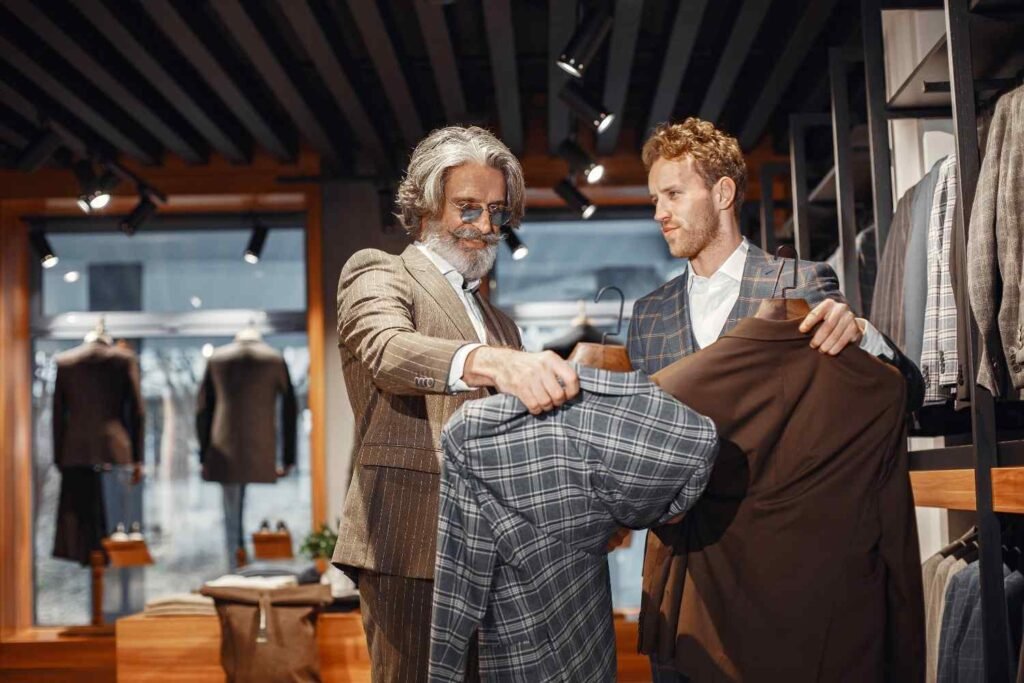
| Architectural Component | Mass-Produced Factory Suits | Artisanal Bespoke Garments |
| Internal Foundation | Chemically fused glue and synthetic backing | Floating full canvas of natural horsehair and linen |
| Pattern Development | Digitally scaled, standardized size blocks | Individually drafted, hand-cut paper pattern |
| Lapel Execution | Flat, mechanically compressed edges | Hand-pick stitched with an organic, dimensional roll |
| Lining Specification | Non-porous synthetic polyester or acetate | Breathable, anti-static Bemberg silk |
| Buttonhole Construction | Machine-stamped with synthetic thread | Hand-cut and bound with pure silk twist |
Final Thoughts
Sartorial value is not dictated by how quickly an item is acquired, but by its structural durability, aesthetic longevity, and role in embracing sustainability. Moving from ready-to-wear to a bespoke wardrobe is an investment in resource efficiency, functional ergonomics, and long-term personal style. A bespoke service creates clothing that resists short-lived trends through precise engineering, adaptability, and structural integrity.
The combination of a minimalist philosophy and meticulous garment engineering forms the basis for a lasting personal archive, one that depends entirely on the long-term performance of each piece. This concept is fully realized through tailored society bespoke services, which prioritize individual posture and historic craftsmanship over transient, mass-produced trends.